Kumo Co-Founder Hema Raghavan Named to Inc.’s 2026 Female Founders 500

Learn more

Forecasting & Planning

Forecasting, Demand Planning & Resource Optimization

Predict demand, inventory needs, workforce requirements, and budgets — all from your existing relational data. Kumo learns from the connections that traditional time-series models flatten away.

Demand ForecastingInventory PlanningWorkforce PlanningCapacity PlanningSeasonal TrendsBudget Allocation

Book a demo and get a free trial of the full platform: data science agent, fine-tune capabilities, and forward-deployed engineer support.

By submitting, you accept the Terms and Privacy Policy.

6

Prediction types

Demand to budgets

0

Feature engineering

Fully automated

<1 hr

To production

Per use case

15+

Industries

Retail, supply chain, SaaS

Loved by data scientists, ML engineers & CXOs at

Catalina Logo

Traditional forecasting vs. Kumo

See how relational learning compares to time-series and tabular approaches.

Input data

Traditional

Flat feature tables per SKU

With Kumo

Full relational graph across products, stores, suppliers

Forecast granularity

Traditional

Category or store level

With Kumo

SKU-store-week precision

Feature engineering

Traditional

Months of manual work

With Kumo

Zero — automated from relational data

Cold-start items

Traditional

No history = no forecast

With Kumo

Graph context from similar items

External signals

Traditional

Manual integration per signal

With Kumo

Learns from connected tables automatically

Setup time

Traditional

6–12 months

With Kumo

Under 1 hour

How It Works

Simply connect your data, start asking predictions, and get results.Want more control? Fine-tune the model for your specific use case.

Connect your data
STEP 1

Connect your data

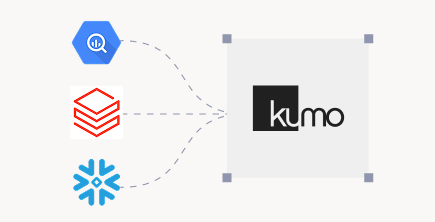
Integrates directly with your warehouse, no additional pipeline setup.

Ask a predictive question
STEP 2

Ask a predictive question

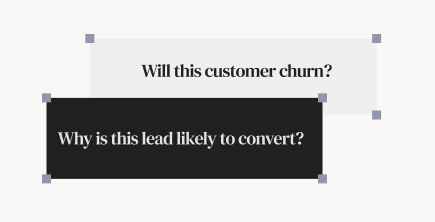
Ask questions in plain English and let Kumo do the modeling for you.

Act on predictions
STEP 3

Act on predictions

Get clear predictions and push them instantly into your workflows.

churn_prediction.pql
PREDICT COUNT(transactions.*, 0, 90, days) = 0
FOR EACH customers.customer_id
WHERE COUNT(transactions.*, -60, 0, days) > 0

3 lines. No feature engineering. No pipeline code.

For developers

Predict in a few lines of SQL

Kumo's Predictive Query Language (PQL) replaces months of feature engineering, model training, and pipeline work with a few lines of SQL-like syntax. Describe what you want to predict — Kumo handles the rest.

Why Kumo

01Zero-Shot Foundation Models

Get accurate predictions on relational data instantly—no training or ML setup required.

Read the KumoRFM announcement
Snail
02Real-Time Predictions
03Native Data Warehouse Integration
04Fine-Tuning at Scale
05Enterprise-Grade Security
06Transparent Explainability

Built by pioneers in AI

Vanja Josifovski

Vanja Josifovski

CEO and Co-Founder

Former CTO at Airbnb and Pinterest

Jure Leskovec

Jure Leskovec

Co-Founder & Chief Scientist

Stanford Professor · Co-creator of RDL and GNN

Hema Raghavan

Hema Raghavan

Co-Founder & Head of Engineering

Former Sr. Director of Engineering at LinkedIn

Loved by data scientists, ML engineers & CXOs at

Catalina Logo

Peer-reviewed

Built on world-class research

Kumo is built on 40+ peer-reviewed papers at NeurIPS, ICML, and KDD.

RFMZero-shotFine-tunedTransfer
ICML 2024

KumoRFM: A Relational Foundation Model for Predictive Analytics

K. Huang, M. Fey, J. Leskovec et al.

A foundation model for relational data — pre-trained across schemas, it delivers accurate predictions out of the box and improves with fine-tuning.

Read paper
ABC
NeurIPS 2024

Relational Deep Learning: Graph Representation Learning on Relational Databases

M. Fey, W. Hu, K. Huang, J. Leskovec et al.

Learning predictive models directly on relational databases, eliminating the feature engineering pipeline.

Read paper
T1T2T3T4T5+20+20+23+22+35BaselineKumo30 tasks
NeurIPS 2024 · Datasets Track

RelBench: A Benchmark for Deep Learning on Relational Databases

J. Robinson, R. Miao, K. Huang et al.

An open benchmark for evaluating relational prediction methods across 11 databases and 30 tasks.

Read paper

Your relational data already contains the forecast signal.

See what Kumo can predict from your existing database — no feature engineering required.